I've always been fascinated by inefficiency. Not in a good way. More like watching someone manually copy-paste data between spreadsheets when a simple script could do it in seconds. Or seeing engineering teams spend hours coding UI elements that non-technical team members could build themselves.
The pattern is everywhere: smart people doing manual work that could be automated. Teams waiting on specialized skills for tasks that could be democratized. Time and energy consumed by maintenance instead of creation.
And as we worked with more customers, I kept noticing the same pattern playing out with product tours. Teams spending absurd amounts of time building tours manually, watching them break, rebuilding them, watching them break again. An endless cycle of maintenance that consumed resources without creating new value.
Teams spend ten hours building a single tour, only to watch it break after the next engineering release. They maintain tours quarterly, cover maybe 20% of their workflows, and spend six figures annually just keeping things from falling apart. The tours are always out of date. Users get confused. Support tickets pile up. And the team? They're stuck in that same endless loop.
Something fundamental is broken here. And it's not just about product tours. It's about the entire model of manual creation and maintenance in a world where software moves faster every day.
Let's start with the obvious one: building a single product tour takes forever. Our data shows it takes more than ten hours to author a single flow. Ten hours. For one tour. That's not including the back-and-forth with stakeholders, the QA testing, or the inevitable rounds of "can we tweak this one more time?"
Think about what ten hours actually means for your team. Your PM spends a full workday (or more) clicking through your product, writing copy, and configuring steps. Your designer reviews it to make sure it matches your brand. Your engineer gets pulled in to fix that one selector that won't work. Your content person edits the messaging. Your product marketing lead weighs in on positioning.
And that's just for one tour. Most companies need fifteen to twenty tours minimum to cover their core workflows. Do the math: that's one hundred fifty to two hundred hours of work just to get basic coverage. That's nearly a full month of someone's time.
The real kicker? By the time you finish building tour number fifteen, tour number one is probably already broken.
Here's the thing nobody tells you about product tours: they're incredibly fragile.
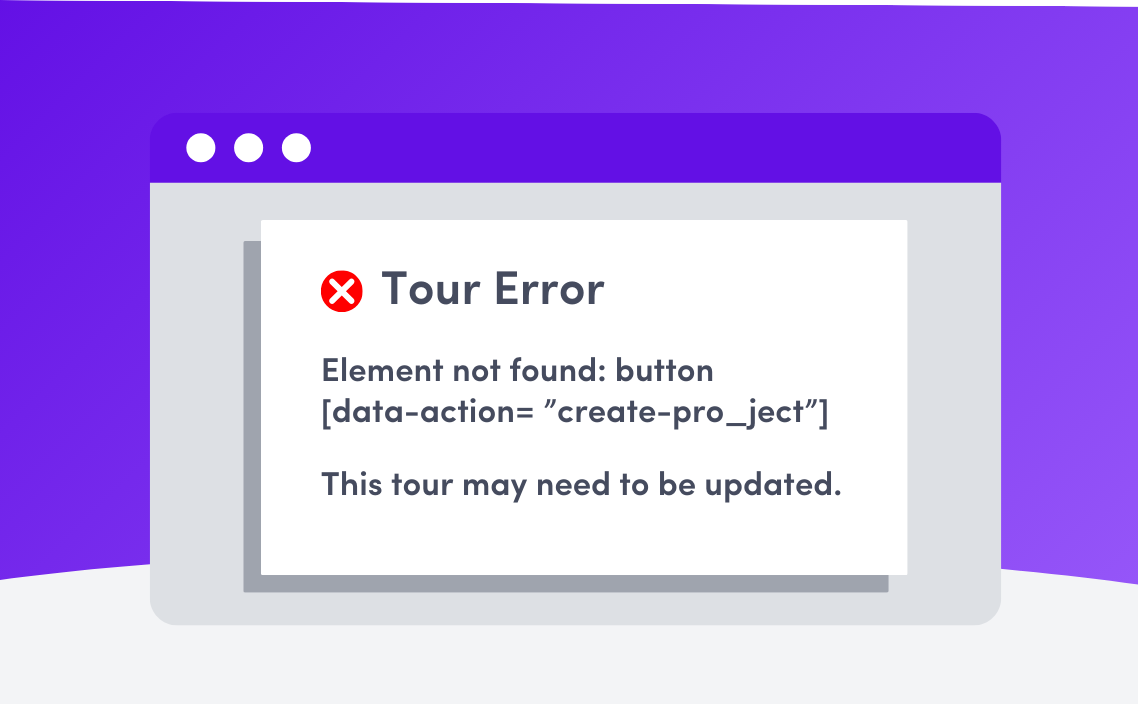
Your engineering team ships a new feature. Maybe they refactor some code. Perhaps they change a button's class name or move an element in the DOM. Suddenly, three of your tours are pointing to elements that don't exist anymore. The tooltips appear in the wrong place. The highlights are off. Users click "next" and nothing happens.
We're seeing teams spend three hours per quarter per flow just on maintenance. That's twelve hours per year, per tour. Multiply that by twenty tours, and you're looking at two hundred forty hours annually just keeping existing tours from breaking.
The impact is severe. Deloitte's 2025 research into retail banking shows 38% of new customers leave mid-onboarding if it takes too long, directly tying churn to perceived effort and waiting time. Meanwhile, Gartner's survey found that only 23% of digital workers are completely satisfied with their work applications, down from 30% just two years earlier. When tours break between steps, users don't just skip ahead. They abandon entirely. One broken step, and your carefully crafted onboarding becomes a dead end.
The real damage isn't even the time spent fixing tours. It's the opportunity cost. While your PM is hunting down broken selectors, they're not talking to users. They're not building new features. They're playing whack-a-mole with UI elements that have moved.
Poor product experiences cost businesses revenue, customers, and team productivity. Manual product tours break after every release, leaving users frustrated and teams overwhelmed
This is the one that really gets me.
Even with all that time and effort, most product tours only cover about 20% of real user workflows.
Why? Because building tours is so time-intensive that teams have to prioritize ruthlessly. You build tours for your most common use cases, your most important features, your highest-value customers. Everything else? Users are on their own.
Here's what we know: Forrester's 2025 research found that 84% of businesses that focused on improving customer experience saw revenue increases. That's huge. But what about the other 80% of workflows that don't have tours? Those features see lower adoption, more support tickets, more user frustration.
We're leaving value on the table for users and for the business because the current model makes comprehensive coverage impossible.
Here's something most people don't realize: product tours aren't just a PM problem. They touch almost everyone.
Marketing needs to align messaging and brand voice. Engineering gets pulled in when selectors break or complex workflows need mapping. Design ensures visual consistency and brand adherence. Data and Analytics teams track completion rates and user behavior. Sales wants tours that support their demos and customer conversations. Customer Success deals with the support tickets when tours fail.
That's six teams at minimum that get interrupted every time you need to build or fix a tour.
But here's the problem: you can't improve the experience when your tools keep breaking. Broken tours aren't just wasting time. They're actively preventing you from delivering the experiences that drive growth.
There's a fundamental mismatch happening in software right now.
Engineering velocity is accelerating. AI-assisted coding is real. Teams ship faster, iterate quicker, and deploy more frequently. That's good. That's progress.
But product tours? They're stuck in the old model. Manual authoring, visual editors, point-and-click configuration. Every time engineering gets faster, the gap widens between what your product can do and what your tours can explain.
Your code moves at two times speed. Your product evolves daily. But your tours update quarterly if you're lucky.
So here's what we did about it at Candu: we killed manual product tours.
Not the concept of guiding users. That's more important than ever. We killed the way they're built. The ten-hour authoring sessions. The fragile selectors. The quarterly maintenance scramble. All of it.
We built something called Capture Flow. And it solves every problem I just described.
The ten-hour creation problem? Gone. With Capture Flow, you open our Chrome extension, hit Start Capture, and just do the task you want to turn into a tour. Click through inviting a user, setting up a project, configuring a report, whatever the workflow is. As you click, Candu's AI generates the tour content, identifies the right selectors, and fills in the copy in real time. When you're done, you review and edit inline. Reorder steps, tweak the text, adjust targets. That's it. What used to take ten hours now takes minutes.
Tours breaking after every release? Fixed at the source. Here's why this is fundamentally different from every other product tour tool: Candu connects directly to your GitHub repository. Your code is the source of truth, not the DOM. So when your engineering team ships a change, Candu already knows. It detects drift, flags what's changed, and proposes updated selectors automatically. We call this self-healing, and it means your tours stay accurate without anyone lifting a finger. In our testing, we hit 92% selector accuracy on the first generation. That's not after rounds of manual fixing. That's out of the box.
Only covering 20% of workflows? We found the other 80%. When Candu connects to your codebase, it doesn't just sit there waiting for you to record tours one by one. It reads your code, your docs, your UI patterns, and it discovers the workflows that exist in your product. In our prototype, it found over 80 workflows automatically and prioritized 20 that should have tours. Your long tail of undiscovered features? Candu finds them for you and drafts the tours before you even think to ask.
Six teams getting pulled into every tour? Now it's one person reviewing. Because the AI drafts the content, identifies the selectors, and generates the steps, the role of your PM shifts from author to editor. They review what Candu proposes, approve it, and publish. No more pulling in engineering to fix selectors. No more waiting on design to review copy placement. No more content bottleneck. One person, reviewing AI-generated tours that are already 90% there.
Most product tour tools try to make manual creation faster. A nicer drag-and-drop editor. A few AI-generated copy suggestions. That's an improvement, sure. But it's still the same broken model: humans author tours by hand, then scramble to maintain them.
Capture Flow flips the model. The AI does the authoring. Humans do the approving. And because the code is the source of truth, maintenance happens automatically.
Think of it this way: traditional tour tools are like giving someone a faster typewriter. Capture Flow is the word processor. Same job, completely different paradigm.
And we're just getting started. Capture Flow is the foundation for what comes next: tours that don't just show users what to do, but do it for them. Agentic workflows where the AI completes tasks on behalf of your users, not just points them in the right direction.
If your team is spending dozens of hours maintaining product tours, if your users are abandoning incomplete onboarding flows, if you're covering a fraction of what users need to learn, you're not failing at product tours. The model itself is failing you.
The future isn't better tools for manual tour creation. It's making manual creation obsolete entirely.
That future is here. Record your first Capture Flow →